

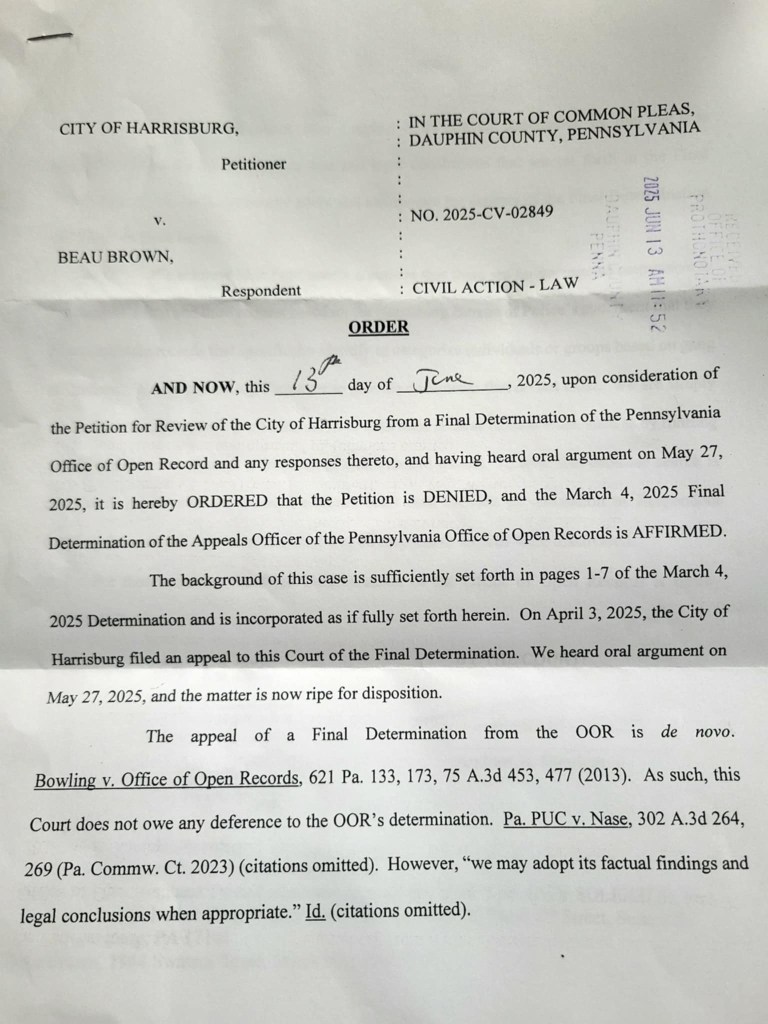
Harrisburg, Pennsylvania — In a closely watched public transparency case, Beau M. Brown, a citizen journalist and longtime Harrisburg resident, successfully defended his Right-to-Know Law (RTKL) request in court against the City of Harrisburg, which sought to overturn a partial ruling in Brown’s favor.
“I won in court against the City of Harrisburg,” Brown posted on social media. “Now they must identify how many national gang-affiliated arrests and how many undocumented individuals charged with crimes occurred within city limits over the last several years.”
Brown originally submitted an RTK request to the City on October 16, 2024, asking for:
- Arrests or citations involving members of the Tren de Aragua gang;
- Arrests or citations involving MS-13 members;
- Arrests or citations of undocumented immigrants; and
- Arrests or citations tied to organized crime, spanning a three-year period.
The City, through its Open Records Officer Pamela Lastimosa-Schwartz, denied the request in full, claiming that no such records existed or could be identified. Brown appealed the denial to the Office of Open Records (OOR), which issued a Final Determination partially in Brown’s favor, ordering the City to conduct a good faith search of existing databases.
Rather than comply, the City of Harrisburg filed a Petition for Review in the Dauphin County Court of Common Pleas, seeking to reverse the OOR’s directive.
Brown, representing himself pro se, argued in court that the City had misrepresented its capabilities and downplayed its access to searchable data on immigration and gang-related arrests. The hearing was held on May 27, 2025, before Judge Andrew H. Dowling.
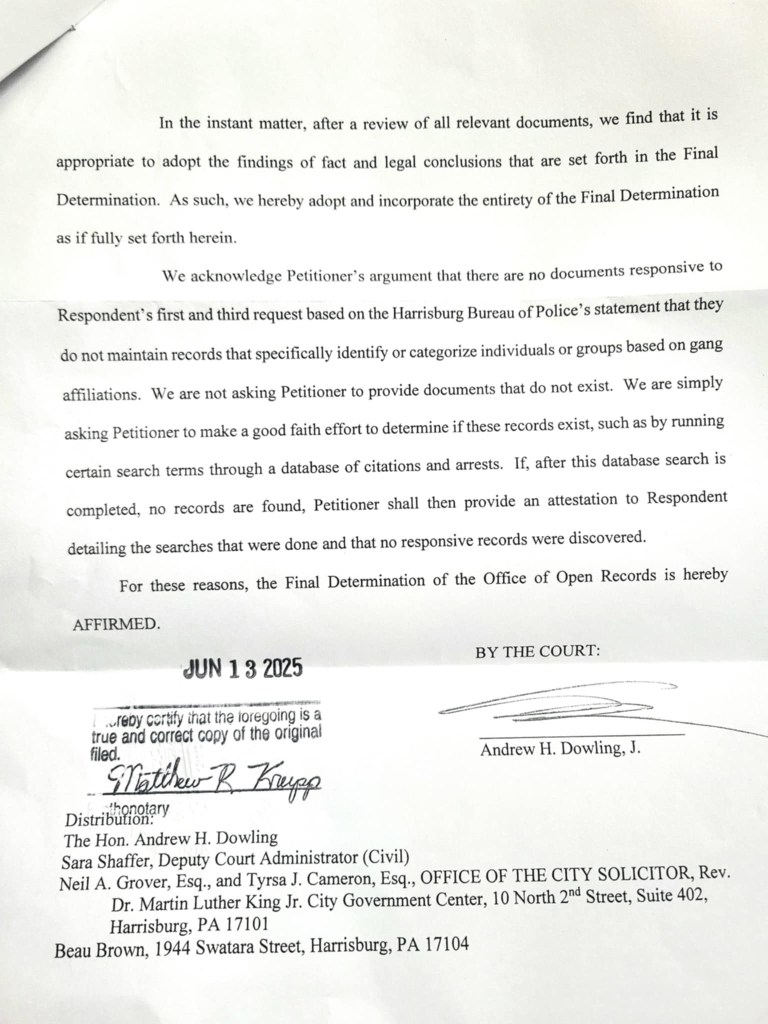
In a June 13, 2025 ruling, Judge Dowling denied the City’s petition and affirmed the OOR’s determination, writing:
“We are not asking [the City] to provide documents that do not exist. We are simply asking [the City] to make a good faith effort to determine if these records exist, such as by running certain search terms through a database of citations and arrests.”
The decision reinforces that under the Right-to-Know Law, agencies are obligated to make a reasonable search—not merely assert nonexistence—and must explain their efforts with specificity.
Brown responded to the outcome by declaring:
“Proclaiming victory and receiving victory!”
The court’s ruling stands as a strong affirmation of transparency and public accountability, especially around sensitive law enforcement practices involving gang activity and undocumented individuals. It also marks a significant win for pro se advocates, reinforcing that citizens can—and do—prevail against institutional resistance.


 Harrisburg100
[…] Chang Outlines Quiet Administration Motive to Support Israeli Strikes Against Iran Citizen journalist prevails in court over City of Harrisburg in immigration and gang records ca… […]
LikeLike