

By: Sean Guay
Harrisburg, Pennsylvania – Upon news of his death, Frank (historically know by the nickname Hercules) was quoted in a Philadelphia newspaper column from 1790. According the the National Gazette:
Frank remembered when the Indian smoked his pipe and when the forest covered what is now the site of Harrisburg. He used to say he had ‘turned many a furrow between the Canal and the bridge across the river.’
In the year 1733, Frank (Hercules) was the African American slave who brought friendly Native Americans to the aid of John Harris, Sr., when he was tied to the now famous mulberry tree on Front Street, Harrisburg, Pennsylvania, where he was to be burned at the stake by a tribe of furious Indians.
According to legend, because Hercules could speak the Native language, he was able to negotiate the release of Harris, Sr., according to the book African American History of Harrisburg.


After saving the life of his Master, Hercules was freed as a slave, and he then began the free African American community of Harrisburg. Harris was so grateful that he granted Hercules his freedom and some land on which he could live after Harris’ death.
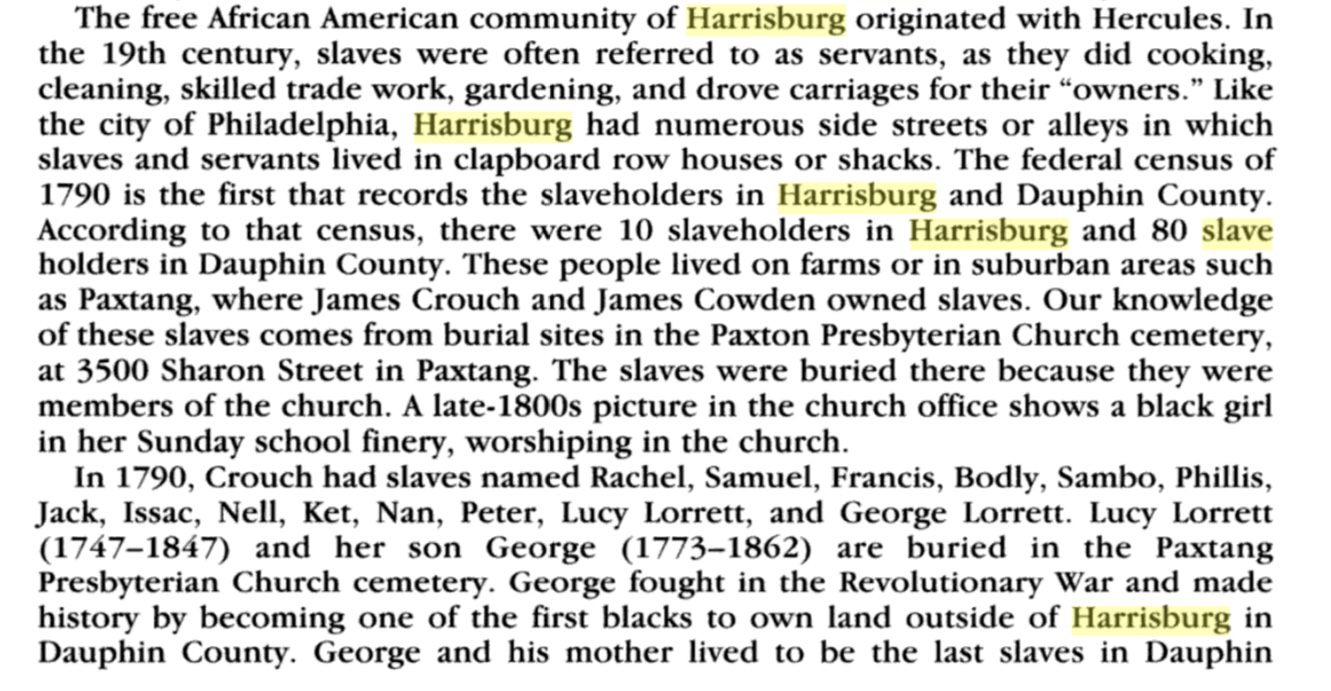
There were 10 slave holders in Harrisburg, and 80 slaveholders in Dauphin County, as recorded in the federal census of 1790. Burial sites of those African American slaves are located in the Paxton Presbyterian Church cemetery at 3500 Sharon Street in Paxtang, where they were members of the church.

33 years after the assassination attempt at the mulberry tree on Front Street, Harris’ son, John Harris Jr., build his mansion at the same location where it stands today.
Harris and his family were considered the principal store keepers on the American frontier; and at his house two notable “council fires” were held with the Indians of the Six Nations and other tribes. Harris Jr. officially founded Harrisburg in the year 1785.
Harrisburg’s site along the Susquehanna River is thought to have been inhabited by Native Americans as early as 3000 BC. Known to the Native Americans as “Peixtin”, or “Paxtang“, the area was an important resting place and crossroads for Native American traders, as the trails leading from the Delaware to the Ohio rivers, and from the Potomac to the Upper Susquehanna intersected there.

Coming Soon: The Story Of The Paxton Boys


 Harrisburg100
Be careful with some of the histories presented in those 100 year-old county history books. They leave a lot out. Harris did free Hercules, but did not give him any land. What he did was give him the right to live free on Harris family land for the rest of his life. John Harris also did not free any other of his many slaves. On his death, he left them in his will to his surviving family members.
Many details on the early African American history of Harrisburg is in the book: Year of Jubilee. http://www.afrolumens.com/yoj.htm
A complete chapter on Hercules starts on page 50.
LikeLiked by 1 person
Frank and Hercules were not the same person. Frank was born in 1745, after the mulberry tree incident would have occurred, and was enslaved by John Harris Jr.
LikeLike
A follow up to my earlier comments about the errors in old sources, and a thank you to Alex for stating explicitly that Frank and Hercules were two very different people. I can add a bit more information. The original obituary for Frank, who died in the Dauphin County Poor House in 1839, contained numerous errors, the biggest being the estimated birth year of 1745. This was probably estimated from the mistaken belief that Frank appeared to his caretakers to be much older than he really was. In November 1839 he would have been 73 and six months old, and not “more than ninety year of age,” as stated. It was very common to overestimate the ages of formerly enslaved elderly people, probably due to the lifetime of harsh work and poor living conditions forced upon them. The writer of the article seems to give veracity to Frank’s account of his youth by placing the Iroquois leader Logan in the vicinity of Harrisburg in 1760. Contemporary accounts of Logan’s life do not indicate in which part of central Pennsylvania he lived, but it is generally agreed that Logan, at about the age of 45, moved his family to Ohio in 1770, at which time Frank would have been four years old and certainly would not have “played and wrestled” with the man.
John Harris II (“the Founder”) as according to law, registered Frank’s birth with the prothonotary of Lancaster County (Dauphin County not yet separated from Lancaster) on October 9, 1780, along with two other enslaved young men, Jack, age 48 and Isaac, age 16. In his registration document, Harris wrote that “Franck” was “aged 14 years last May,” making his year of birth 1766. Harris died in 1791 and Frank, then about 25 years old, ended up with Adam Orth, an iron forge owner of Lebanon Township, probably through sale of Harris’ assets to settle his estate. The obituary states that Frank was manumitted by Orth, which would have had to occur by 1794 or earlier, the year of Orth’s death.
There is one other possibility relating to the manumission of Frank, assuming that bit of the obituary is true, and that is that the manumission may have come from Adam Orth, a Harrisburg lawyer and grandson of the Adam Orth the forge owner. When Orth the forge owner died in 1794, his son Henry inherited the forge and most of the estate. If Frank were working at the forge, he may have passed on to Henry, and then subsequently to Henry’s son Adam, who died in 1833. By that time, Frank would have been an old man in his sixties. It was not uncommon for enslavers to manumit aged enslaved persons rather than provide care for them once they ceased to be productive workers — effectively turning them out on the streets to fend for themselves, a harsh reality of the system. This would be one explanation for why Frank died in the county poor house, which was a very miserable existence for the inmates there.
George Nagle, Harrisburg, editor: afrolumens.com
LikeLike